Vikash Kumar Surana is a Qualified Company Secretary, Associate Member of CISI UK, and Founder of THE FINOPS Services (est. 2017). With 15+ years of expertise in indirect taxation (GST, Excise, VAT, DGFT, MSME subsidies like PLI, RODTEP), he specializes in tax strategy, litigation, and compliance across industries like manufacturing, ports, steel, and healthcare.
Introduction:
The Production Linked Incentive (PLI) scheme of the Government of India is a form of performance-based incentive, or PLI, scheme of the Government of India is a form of performance-linked incentive to provide companies with incentives for incremental sales from products manufactured in domestic units. It is aimed at boosting the manufacturing sector and reducing imports. The objectives of these schemes include supporting the Make in India initiative, incentivising foreign manufacturers to start production in India, and incentivising domestic manufacturers to expand their production and exports. The Government of India (GoI) has introduced ₹1.97 lakh crore (US$28 billion) worth of PLI schemes for 13 sectors. As part of the Make in India strategy, it provides five-year incentives to qualified enterprises based on incremental sales growth. The initiative intends to reduce India’s dependence on foreign countries such as China while increasing employment in labour-intensive industries. This paper aims to provide a detailed description of the Production Linked Incentive (PLI) scheme, including its objectives, benefits, and issues.
It encourages both global and domestic enterprises to establish or expand production facilities in India. The PLI initiative encourages foreign investment in cutting-edge technology, stimulates exports, and connects India to the global supply chain. To qualify for PLI benefits, interested enterprises must first meet certain eligibility requirements.
Objectives of the PLI Scheme:
The primary goals of the PLI scheme are to comply with World Trade Organization standards while also promoting fair treatment for domestic and export sales.
It seeks to attract foreign investment in sophisticated technology and core areas, increase exports, and contribute to economic growth.
The PLI system provides a variety of incentives, including reduced import and export duties, tax breaks, low-cost land acquisition, and assistance for anchor investors overseeing new projects.
The scheme promotes sustainable development and investments in labour-intensive sectors, making it a useful and accessible initiative.
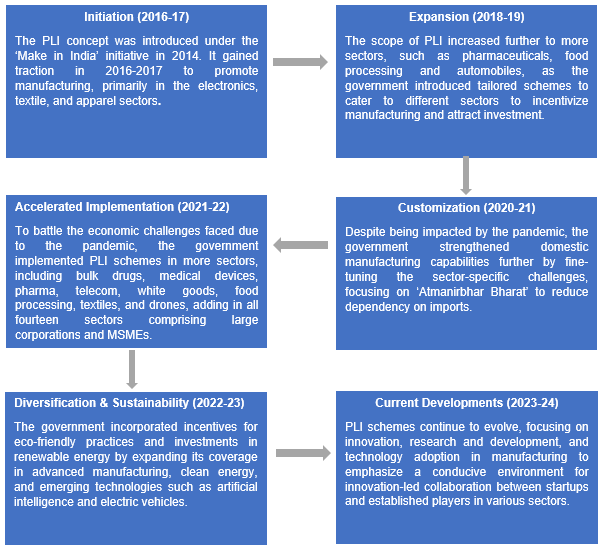
Unlocking growth: Tracing the evolution of PLI schemes
How the PLI works – Step by Step:
1. Selection of Sectors: The government recognizes strategic sectors in which India wishes to
a. Reduce the reliance on imported goods.
b. Increase exports.
c. Attract global investment.
d. Examples include handicrafts, electronics, pharmaceuticals, automobiles, textiles, and solar energy.
2. Eligibility criteria for companies: To qualify, the companies must meet certain criteria, such as:
a. Minimum investment commitment.
b. Minimum annual production or sales.
c. Domestic value addition (DVA) requirements.
d. Often, a base year is selected to compare future output increases.
3. Application and Approval:
a. Companies apply to the PLI plan in a specified sector/organization.
b. The relevant ministry examines submissions and selects suitable enterprises.
c. Once accepted, the corporation agrees with the implementing agency.
4. Performance-Linked Incentives:
a. They are calculated based on increased sales or output over the base year.
b. For example, if a company produces goods worth ₹100 crore greater than the base year and the incentive rate is 5%, they will receive ₹5 crore in incentive.
c. These incentives are often paid out on an annual or quarterly basis when performance is verified.
5. Monitoring and disbursement:
a. Companies must present compliance reports and paperwork.
b. Government agencies or third-party auditors may verify the claims.
c. Incentives are distributed only after verification
Sectors Covered (as of 2024):
Initially launched with 3 sectors in 2020, it has expanded to 14 key sectors, including:
Mobile phones & electronic components.
Pharmaceuticals & medical devices.
Automobiles & auto components.
Telecom & networking products.
IT hardware.
Textiles & garments.
Food processing.
White goods (ACs, LEDs).
Specialty steel.
Solar PV modules.
Advanced chemistry cells (ACC) batteries.
Drones & drone components.
Positive Aspects of the PLI Scheme:
Supporting Key Sectors and Promoting Innovation and Technology: PLI plans target industries critical to economic growth, technological innovation, and strategic relevance. To be eligible for incentives, businesses must use sophisticated technology and processes that drive innovation and efficiency benefits.
Improving Export Competitiveness: The policy fosters export-oriented production, which increases India’s international competitiveness and boosts exports.
Strengthening Industrial Infrastructure: The initiative promotes the development of industrial infrastructure, making it easier for businesses to construct or expand manufacturing facilities.
Reducing Dependence on Imports: By encouraging home manufacturing, the PLI scheme attempts to reduce India’s reliance on imports, increasing self-sufficiency and lowering trade deficits.
Attracting Foreign Investment: PLI policies encourage foreign corporations to establish manufacturing facilities in India by providing incentives, boosting technology transfer, and increasing foreign direct investment.
Conclusion:
The Production Linked Incentive (PLI) Scheme is a transformative initiative taken by the Indian government to establish the country as a worldwide manufacturing hub. By linking incentives to production growth, the scheme encourages businesses to invest, expand, and manufacture locally. The initiative not only promotes Make in India, but it also encourages innovation, job development, and export competitiveness.
However, the system has faced obstacles such as implementation delays, stringent qualifying criteria, and budget constraints. To fully realize the benefits of the PLI system, continued efforts to overcome these difficulties are critical.
The content published on this blog is for informational purposes only. The opinions expressed here are solely those of the respective authors and do not necessarily reflect the views of Fintrac Advisors. No warranties are made regarding this information’s completeness, reliability, or accuracy. Any action taken based on the information presented in this blog is strictly at the reader’s own risk, and we will not be liable for any losses or damages resulting from its use. It is recommended that professional expertise be sought for such matters. External links on this blog may direct users to third-party sites beyond our control. We do not take responsibility for their nature, content, or availability.